TrackIQ Proof – Klagenfurt & Frankfurt: faster through smarter power distribution
These articles might also interest you:
- From TrackIQ pacing to your device: FIT export for Garmin® Edge & ZWO workouts for Zwift®/MyWhoosh® etc. — 14.02.2026
- GPXPower: The 4 Key Levers – Mass, CdA, Cᵣ and Power — 08.02.2026
- TrackIQ – Optimal Performance Strategy Through Physics — 25.10.2025
- Master Your Race Day with RaceYourTrack — 24.10.2025
TrackIQ Proof: Two IRONMAN® courses, identical assumptions — clear time gains
TrackIQ computes a physics-based pacing strategy along a course. To do this, thousands of possible power-distribution profiles are simulated and benchmarked against each other — under the fixed constraint that Normalized Power (NP) / Weighted Power (WP) stays the same. Using modern simulation techniques, TrackIQ finds the combination that minimizes total ride time at the same physiological load.
In other words: you don’t just get “a profile” — you get the best solution out of many, all sharing the same load. That’s exactly why TrackIQ is so valuable for long-distance racing, where the goal is not only to get off the bike fast, but to do so in a controlled way.
Setup (identical for both courses)
- Weight (rider + bike): 80 kg
- Rolling resistance: c_r = 0.003
- Aerodynamics: c_wA / CdA = 0.30
- FTP: 250 W
- Intensity: 80%
- Target power: 200 W
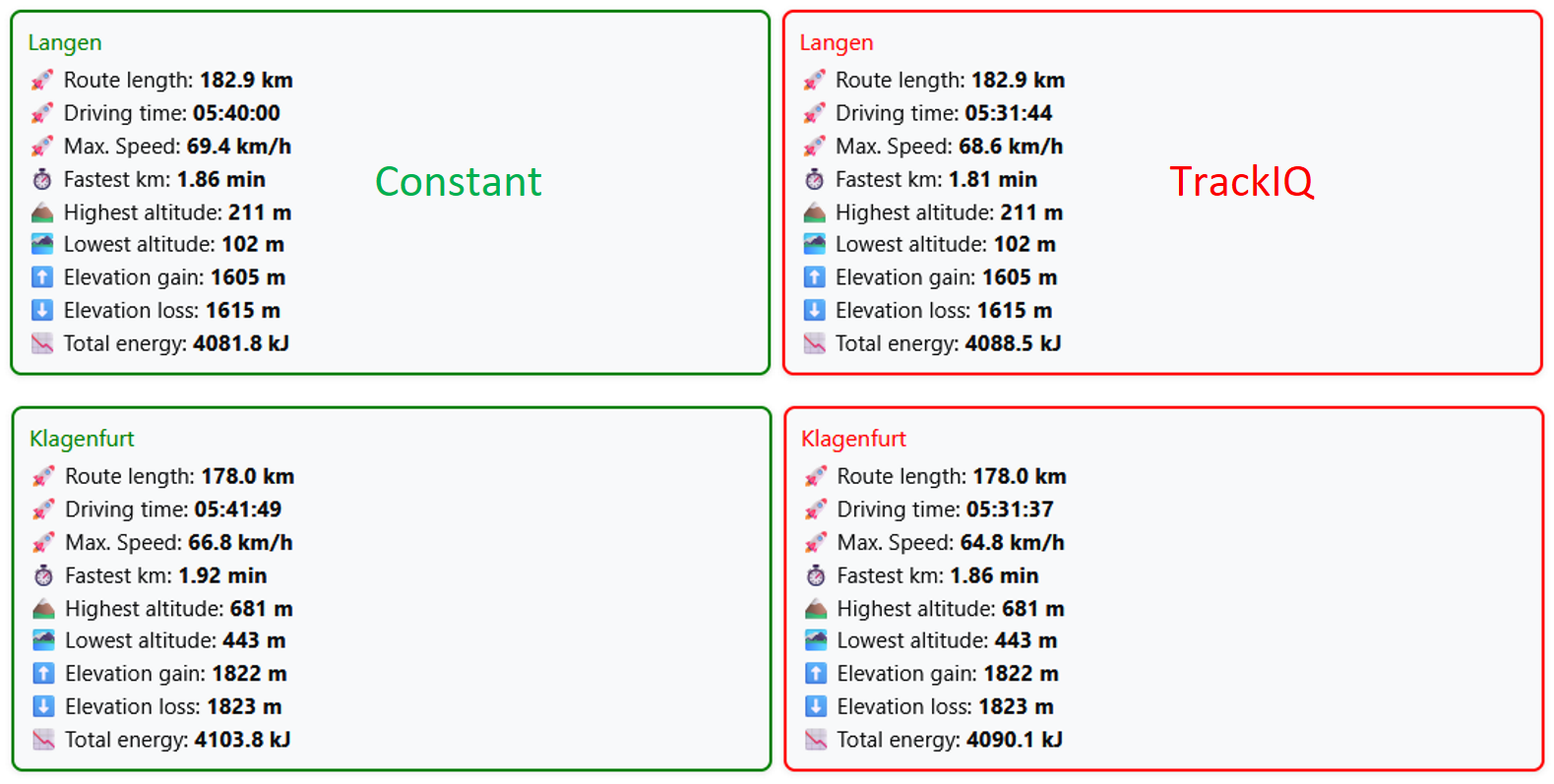
We compared: - Baseline (GREEN): constant 200 W for the entire course - TrackIQ (RED): same target load, but optimized power distribution
Important for the proof: Normalized Power (NP) / Weighted Power (WP) is identical between Baseline and TrackIQ. That means the physiological load in the model is the same — TrackIQ gains time not by “pushing harder,” but by distributing effort more effectively.
Result 1: Frankfurt / Langen (182.9 km)
- Baseline (GREEN):
- Time: 05:40:00
-
Energy: 4081.8 kJ
-
TrackIQ (RED):
- Time: 05:31:44
-
Energy: 4088.5 kJ
-
Difference (TrackIQ vs. Baseline):
- Time gain: −08:16
- Energy: +6.7 kJ (effectively identical in the context of ~4.1 MJ total work)
This example shows that TrackIQ can still find meaningful time gains even under strict constraints: same NP/WP, virtually the same total work — yet a clearly faster overall time.
Result 2: Klagenfurt (178.0 km)
- Baseline (GREEN):
- Time: 05:41:49
-
Energy: 4103.8 kJ
-
TrackIQ (RED):
- Time: 05:31:37
-
Energy: 4090.1 kJ
-
Difference (TrackIQ vs. Baseline):
- Time gain: −10:12
- Energy: −13.7 kJ
Here the effect is even clearer: TrackIQ is not only faster, it also requires slightly less energy. That’s exactly what optimization is about — distributing power so it’s applied where it translates into real speed.
Combined takeaway
On both courses, TrackIQ (RED) is faster than a constant 200 W strategy — with the same Normalized/Weighted Power. The energy differences are tiny, while the time gains are substantial:
- Frankfurt/Langen: 8:16 minutes faster
- Klagenfurt: 10:12 minutes faster
That’s the core value of TrackIQ: not more load, but the best solution out of many — at the same NP.
Works on any course — and it’s immediately usable
These two courses are just examples. TrackIQ can run on any route — whether it’s a training GPX, your local loop, or a full race course. The result doesn’t stay in “simulation mode”; it becomes a plan you can actually execute.
That’s why TrackIQ lets you export the optimized strategy directly:
- as a FIT file (e.g., for Garmin/Wahoo as structured targets or on-device guidance)
- as a ZWO file (a Zwift workout, ideal for practicing pacing indoors)
So a theoretical model turns into a practical tool: you simulate the best strategy, export it as a workout or device file, and then practice it reproducibly in training — and execute it on race day.