Calculating CdA from Power Meter Data: RaceYourTrack’s Extended Chung Method
🚴♂️ Calculating CdA from Power Meter Data: RaceYourTrack’s Extended Chung Method
How can you determine a rider’s aerodynamic drag out on the road without a wind tunnel or lab setup? That is exactly where the Chung Method comes in.
RaceYourTrack uses an extended version of this physics-based approach to estimate CdA from power meter, GPS, and elevation data—not just on idealized test loops, but also on real-world courses with climbs and descents.
The goal is not just to produce an abstract number. It is to create a practical foundation for aerodynamics analysis, simulation, and pacing.
What is the Chung Method?
The Chung Method, developed by Robert Chung, is a physics-based approach for estimating CdA and rolling resistance from real ride data.
The core idea is simple: the power produced by the rider has to show up in the system’s main resistive forces. These include:
- aerodynamic drag
- rolling resistance
- changes in elevation
- acceleration
Instead of measuring drag directly, the method works backward from the ride’s energy balance. That is what makes it so useful: it works with standard real-world hardware and uses actual ride data as its foundation.
Why the classic Chung Method is not always enough in practice
The classic approach works especially well on steady test loops. On those courses, outside influences are easier to control, and headwinds and tailwinds partly cancel each other out.
But real training and racing usually look very different:
- the course is not flat
- the elevation profile is not constant
- speed and effort are always changing
- real rides contain more dynamics than an idealized test course
That is exactly why it helps to extend the method so it remains robust on normal GPX-based routes, not just controlled test loops.
How RaceYourTrack extends the Chung Method
RaceYourTrack uses an extended implementation that directly incorporates the actual elevation profile of the course into the analysis.
At the core of the process, the model uses the power data and the relevant physical resistance terms to calculate a simulated elevation profile. That profile is then compared against the measured elevation profile of the route.
The system then searches for the parameter values that minimize the difference between the model and reality. This makes it possible to estimate CdA meaningfully even on training rides and race courses with climbs and descents, not just on smooth flat loops.
As soon as a simulation includes real power data, RaceYourTrack can determine the relevant parameters automatically in the background and feed them directly into the rest of the modeling.
Virtual Elevation: Why this approach is so useful
A key building block of the method is so-called virtual elevation.
In simplified terms, the model asks: If the measured power, speed, and assumed resistance parameters are correct, how must the system have behaved in terms of elevation?
If the chosen CdA and rolling resistance are a good match, the modeled elevation stays close to the actual measured elevation of the route. If the parameters are off, the model gradually drifts away from the real profile.
That is exactly why this approach is so powerful: it does not just check isolated data points, but the physical consistency of the entire ride.
What data you need for a reliable analysis
You do not need a perfect lab-style test ride for a good estimate—but clean data helps a lot.
Especially useful are:
- a power meter with plausible power data
- a GPS track with usable speed and elevation data
- as few major interruptions in the ride as possible
- longer sections with reasonably consistent pacing and position
The better the data quality, the more robust the estimate of CdA and rolling resistance will be.
Where the method reaches its limits
Like any physics-based approach, this analysis has limits.
For example, estimation becomes more difficult with:
- highly erratic power data
- frequent stop-and-go riding
- very noisy elevation profiles
- many abrupt speed changes
- strongly changing external conditions during the ride
So the method does not produce a magic number that is universally exact in every situation. What it does provide is a physics-based estimate that can be extremely valuable for training, bike fit, setup comparisons, and race planning when the data quality is good.
For those who think in equations
The energy balance of the extended Chung Method can be described in simplified form as:
$$P_{\text{mech}} = P_{\text{roll}} + P_{\text{aero}} + P_{\text{acc}} + P_{\text{grav}}$$
For real-world courses with elevation changes, this is approximately:
$$P_{\text{mech}} = m g \dot{h} + C_r m g v + \tfrac{1}{2} \rho c_w A v^3 + m v \dot{v}$$
From this, a simulated elevation can be derived:
$$\dot{h}_i = \frac{P_i - C_r m g v_i - \tfrac{1}{2} \rho c_w A v_i^3 - m v_i \dot{v}_i}{m g}$$
$$h_{\text{sim}}(t) = \int \dot{h}_i \,dt + h_0$$
The optimal parameter pair $(c_wA, C_r)$ is the one that minimizes the difference between measured and modeled elevation.
Conclusion
The Chung Method is a powerful physics-based approach for estimating CdA from real ride data.
RaceYourTrack extends this approach for real courses with elevation profiles, so the analysis is no longer limited to ideal test loops. That turns normal power meter and GPS data into a solid foundation for aerodynamics analysis, simulation, and race strategy.
If you are especially interested in when aero sensors make sense and how they differ from post-ride analysis, continue here: Aero Sensors vs. the Chung Method
📚 Source
This method is based on the work of Robert Chung: Estimating CdA from Power Data (PDF), licensed under Creative Commons Attribution (CC BY 3.0).
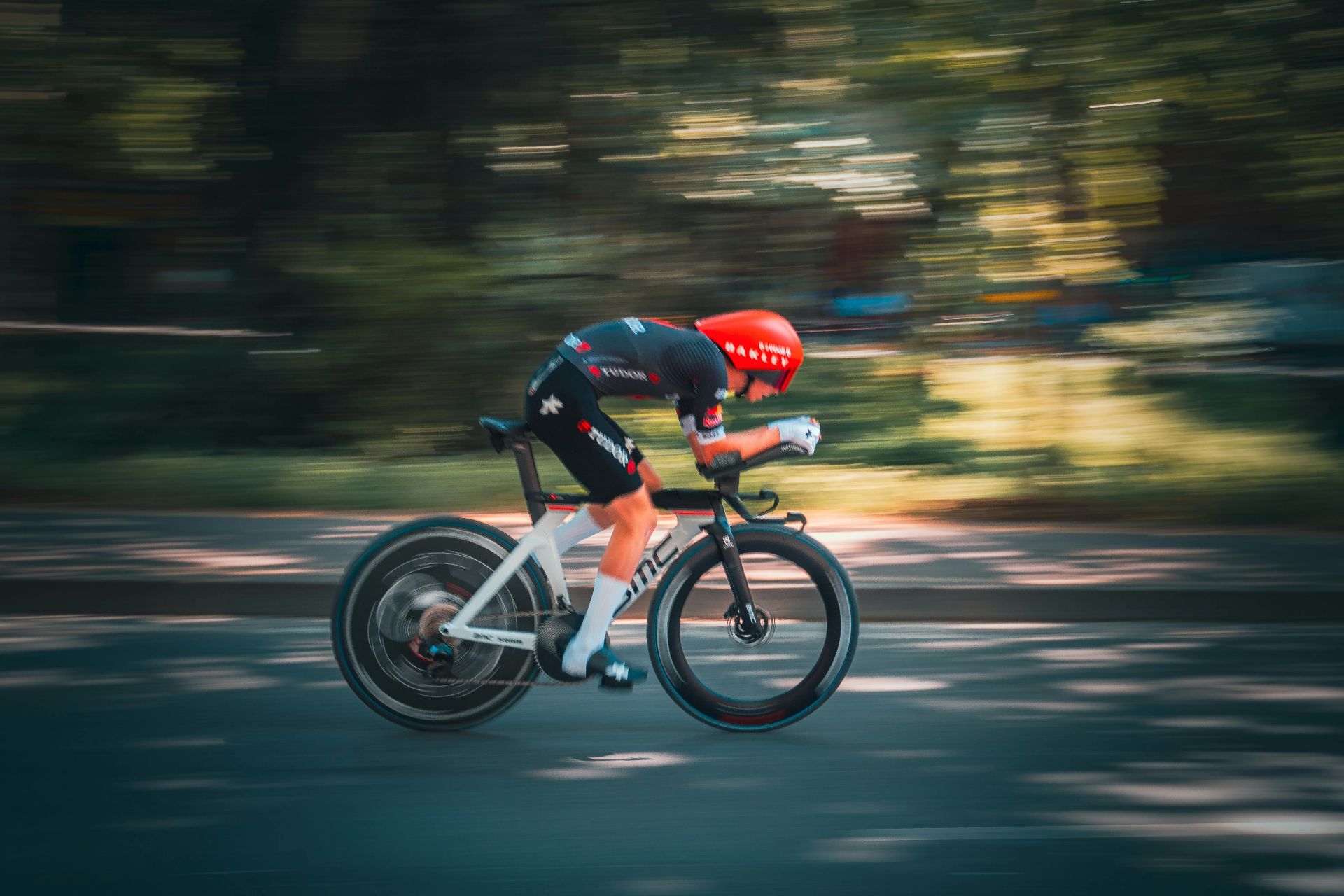
Photo credit: Pexels / Paolo Bici
➡️ Learn more about our simulation physics at RaceYourTrack.com