Aero Sensors in Cycling: Who Really Benefits from Notio, Aerosensor, and Similar Systems?
📡 Aero Sensors in Cycling: Who Really Benefits from Notio, Aerosensor, and Similar Systems?
At first glance, aero sensors seem like the perfect solution for anyone who wants to improve their CdA out on the road: mount the device, ride, watch live data, get faster.
In practice, it is not quite that simple.
These systems can be extremely valuable—especially for structured testing of position, equipment, and setup. At the same time, they are measurement-intensive tools that only deliver truly reliable results when the test setup is sound.
So the key question is not just: “What does an aero sensor measure?”
More importantly, it is: “Who is the effort really worth it for—and when are standard ride data already enough?”
What aero sensors actually do
Aero sensors like Notio, Aerosensor, and similar systems are mounted directly on the bike and typically combine several data sources:
- airflow speed
- pressure and environmental data
- bike speed
- power meter data
From that, they estimate a value that reflects how aerodynamic your current setup is.
That is the big appeal: instead of relying only on feel to judge whether a position change or equipment swap is faster, you get data-based feedback directly out on the road.
What aero sensors are especially good for
Aero sensors are most useful when you want to answer specific comparison questions.
For example:
- Is helmet A more aerodynamic than helmet B?
- Is a different arm or shoulder position actually faster?
- Does a different hydration setup meaningfully change drag?
- Is a specific bike fit adjustment really worth it?
In those scenarios, live feedback can be extremely valuable. You make one change, repeat the test, and get immediate insight into whether the effect is even large enough to matter.
That is why aero sensors are especially interesting for:
- structured aero testing sessions
- bike fitting with a clearly defined question
- equipment-focused fine-tuning
- athletes who are deliberately working on their position
Where things get difficult in the real world
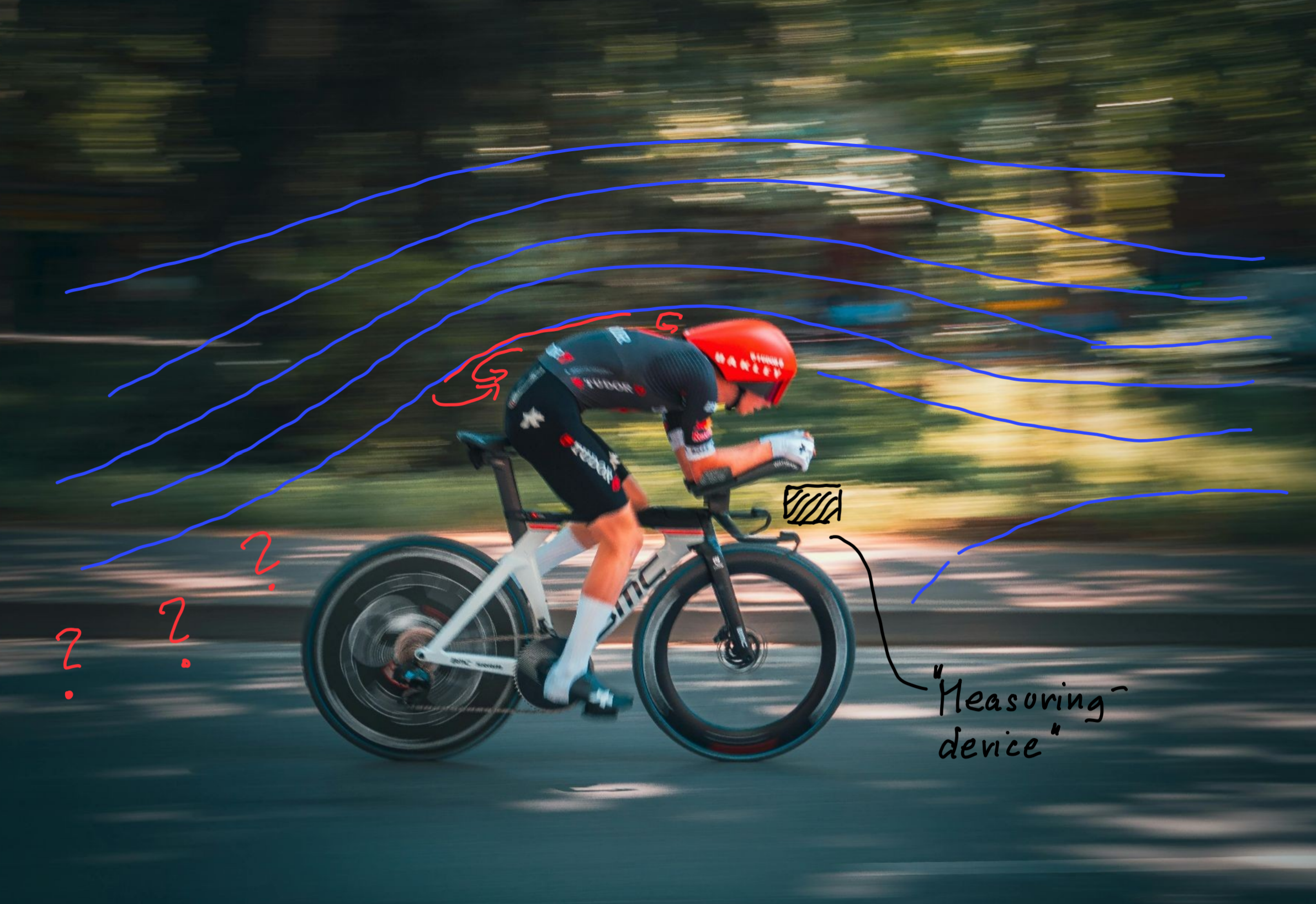
This is also where the challenge starts: aero sensors are sensitive to everything that is hard to control out on the road.
Typical sources of error include:
- gusty or shifting wind
- turbulence around the rider, cockpit, legs, and frame
- small changes in head, shoulder, or arm position
- braking, turns, traffic, and inconsistent riding
- inaccurate assumptions about weight, rolling resistance, or gradient
The issue is not that these sensors are “bad.” The issue is that small aerodynamic differences are often similar in size to the measurement noise in real-world riding.
So if you want to test a very small advantage, you need a very clean protocol. Otherwise, you may end up comparing not two setups, but simply two slightly different riding situations.
Why clean aero testing often fails
Many tests produce weak results not because the hardware is poor, but because the setup is too inconsistent.
Typical mistakes include:
- doing only a single run per setup
- testing in changing wind conditions
- changing too many variables at once
- choosing different lines, turns, or braking points
- inconsistent body position despite a supposedly “identical setup”
The smaller the expected benefit, the more important repetition, consistency, and discipline become.
Ideally, a good test answers one specific question at a time—not five at once.
Who an aero sensor is really worth it for
An aero sensor makes the most sense if you:
- want to run structured aero testing on a regular basis
- are optimizing position and equipment in a very targeted way
- are willing to learn and apply solid testing methodology
- want not only to spot small differences, but also to validate them properly
In short, an aero sensor is most worthwhile for athletes who will not just own it, but also use it methodically.
Who probably does not need an aero sensor
Buying one is often less worthwhile if you:
- mainly just want to know roughly how aerodynamic you are
- do not have the time or interest for repeatable testing sessions
- rarely ride under controlled conditions
- already collect solid power meter and GPS data and are more interested in post-ride analysis
In those cases, the limiting factor is often not missing hardware, but the lack of a good testing environment or enough stability in the data.
When standard ride data are often enough
Many athletes underestimate how much can already be learned from power meter, speed, and GPS data—especially when those data are clean.
If your goal is more along the lines of:
- understanding real rides better
- evaluating your setup on familiar routes
- carrying an aero estimate into simulations
- working without additional hardware
… then post-ride analysis is often the more practical path.
That is exactly where RaceYourTrack focuses: instead of prioritizing live numbers during the ride, we use real ride data in post-analysis to build a solid foundation for simulation, course analysis, and pacing.
If you want to understand how that approach works technically, here is the background article: Calculating CdA from Power Meter Data: RaceYourTrack’s Extended Chung Method
The most important question to ask before buying
Before you think about buying an aero sensor, one simple question helps:
Do you want to test small setup differences live—or do you want to understand real ride data more clearly after the fact?
If you want live comparisons and are willing to test methodically, an aero sensor can be a very powerful tool.
If your main goal is to analyze real rides, evaluate your setup on the road, and work with the data you already have, extra sensor hardware is often not the first lever to pull.
Conclusion
Aero sensors like Notio or Aerosensor are not gimmicks—but they are not magic solutions either.
They are powerful tools for well-designed aero testing, clean setup comparisons, and focused work on position and equipment. But their value depends heavily on how controlled and consistent your testing actually is.
For many athletes, the real question is therefore not whether an aero sensor is theoretically interesting, but whether it fits their actual training environment and workflow.
Athletes who want to test in a structured way can benefit significantly. But those who mainly want to better understand real rides and get more out of the data they already collect can often go a very long way without additional hardware.
Related reading
- Calculating CdA from Power Meter Data: RaceYourTrack’s Extended Chung Method
- Aerodynamic Drag in Cycling – The Invisible Force Slowing You Down
Note
This article is intended as a practical overview. For reliable aero testing, the deciding factor is not just the hardware, but above all a clean, repeatable testing protocol.