How Does Air Resistance Affect Cycling? Speed, Watts, and When Aero Matters Most
How does air resistance affect cycling?
Air resistance affects cycling by taking a larger and larger share of your power as speed rises. On flat roads, it quickly becomes the dominant force slowing you down. That is why small aerodynamic improvements in body position, clothing, or equipment can save meaningful watts and increase speed.
In practical terms, the faster you ride, the more your performance depends on aerodynamics rather than just weight. On steep climbs at low speeds, gravity matters more. But on flat and fast sections, cycling air resistance is often the main reason extra watts do not translate into much more speed.
A look at the forces – what the data reveals
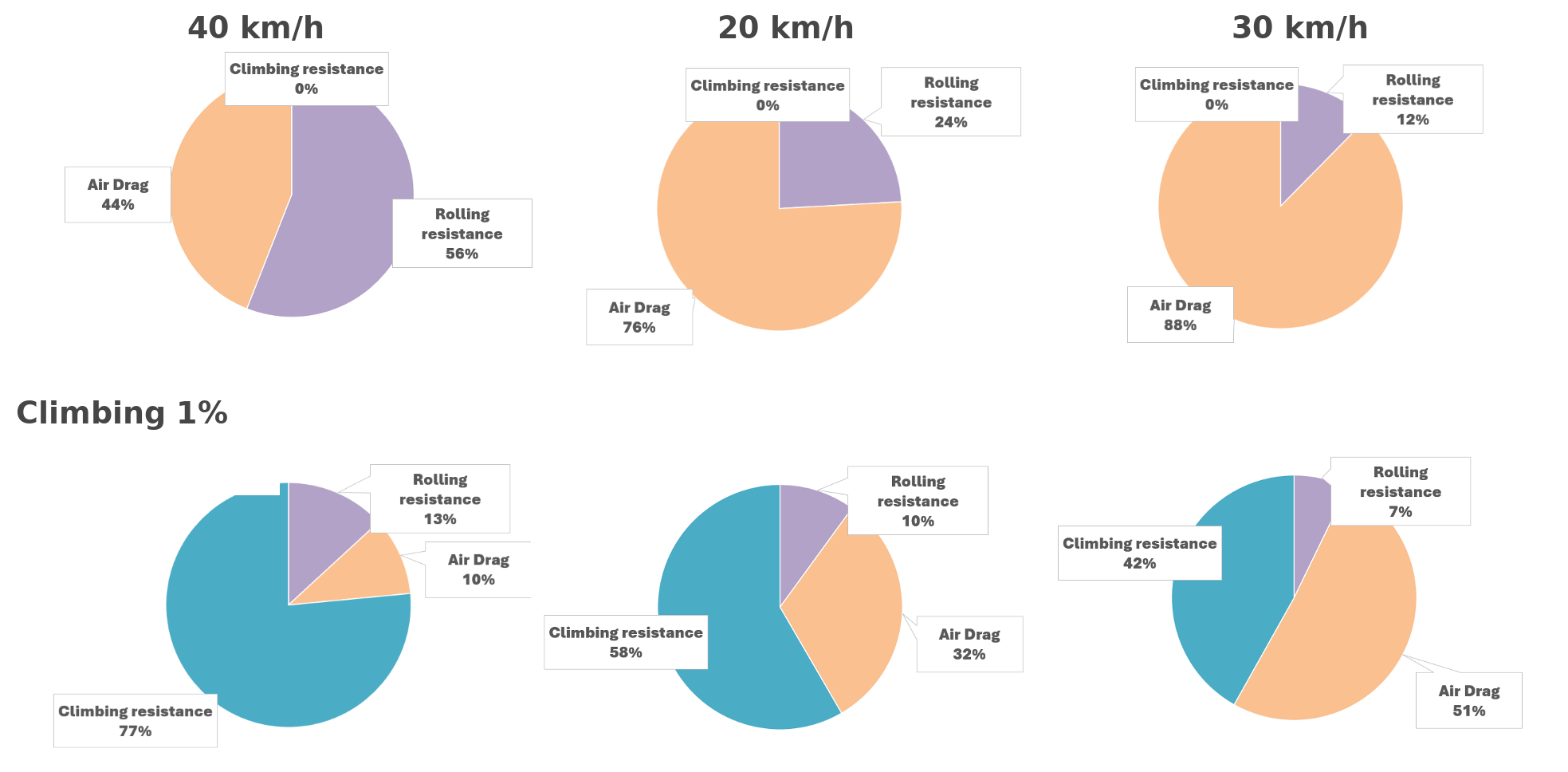
The graphic above breaks down the total power requirements into three main resistances: air resistance, rolling resistance, and gravity.
From left to right, we analyze speeds of 10, 20, and 30 km/h.
Top row: Flat terrain (0% gradient).
Bottom row: Slight climb (1% gradient).
Flat terrain (0% gradient):
- 10 km/h: Air resistance accounts for about 44% of your effort, while rolling resistance takes 56%.
- 20 km/h: The balance shifts dramatically, and air resistance rises to 76%.
- 30 km/h: At this speed, a staggering 88% of your power is spent just pushing air out of the way.
Gentle climb (1% gradient):
- 10 km/h: Gravity is the boss, taking 77% of your power. Air resistance is only 10%.
- 20 km/h: The climb still accounts for 58%, but air resistance has already climbed to 32%.
- 30 km/h: Even on a climb, if you are fast, air resistance (51%) becomes more taxing than the gradient itself (42%).
Technical note: These calculations assume a total mass of 80 kg, a rolling resistance coefficient $c_r = 0.003$, an air density $\rho = 1.2 \text{ kg/m}^3$, a drag coefficient $c_w = 0.4$, and a frontal area $A = 1.0 \text{ m}^2$.
Does air resistance increase with speed?
Yes. Air resistance on a bike increases disproportionately with speed.
That is the key reason riding a little faster on the flat can suddenly feel much harder. At lower speeds, drag is noticeable but manageable. As speed rises, the force from air resistance grows rapidly, and the power needed to overcome it rises even faster.
This is why many riders feel as if they hit an invisible wall once they get into higher speeds on flat roads. You can add more watts, but the speed gain gets smaller because so much of that extra power goes into overcoming the air.
So if you have ever wondered does air resistance increase with speed, the answer is clearly yes, and that is exactly why aerodynamics matters so much in cycling performance.
At what speed does air resistance matter in cycling?
Air resistance matters at almost every speed, but it becomes especially important once speed rises on flat terrain.
A useful rule of thumb is:
- At lower speeds: rolling resistance and gravity can matter as much as, or more than, drag.
- At moderate speeds on the flat: air resistance becomes one of the main limiting factors.
- At higher speeds: air resistance is usually the dominant resistance.
Our example above shows this clearly. On flat terrain, air resistance already takes 76% of total power at 20 km/h, and 88% at 30 km/h. That means the answer to at what speed does air resistance matter is: earlier than many riders think, and very strongly once speed rises on flatter roads.
On steep climbs, the picture changes. There, gravity dominates because your power is used mainly to gain altitude. But speed is only part of the story. Whether air resistance is the main thing slowing you down also depends on the road gradient.
When does air resistance matter more than gravity in cycling?
Air resistance is not always the biggest force slowing you down. Whether drag, gravity, or rolling resistance matters most depends mainly on speed and gradient.
This is one of the most important ideas in cycling performance:
- On flat roads at higher speeds, air resistance is usually the dominant resistance.
- On steeper climbs at lower speeds, gravity becomes the main limiter.
- On rolling terrain, both aerodynamics and weight can matter at the same time.
Flat roads and higher speeds
On flat terrain, air resistance quickly becomes the main reason riding faster gets so difficult. Once speed rises, more and more of your power goes into pushing air out of the way rather than into increasing speed.
That is why aerodynamics often matters more than saving a small amount of weight on flat and fast sections. If your goal is to ride faster here, improvements in position, clothing, and overall CdA usually have the biggest effect.
Steep or longer climbs at lower speeds
On climbs, the situation changes. At lower climbing speeds, gravity dominates because a large share of your power goes into gaining altitude and increasing potential energy.
In these conditions, total system weight becomes more important, while aerodynamics matters less than it does on fast flat roads. That is why a lightweight setup helps most when gradients are higher and speeds are lower.
Rolling terrain
Many real rides sit somewhere between these extremes. On rolling terrain, you may climb at lower speed in one section and then ride fast on flatter terrain a few minutes later.
In that situation, neither aerodynamics nor weight tells the whole story on its own. A reasonably light setup and solid aerodynamics both matter, which is why balanced choices often make more sense than extreme ones.
So the better question is not simply aero or weight?
It is: where are you riding, and at what speed?
What determines air resistance on a bicycle?
Air resistance on a bicycle depends mainly on three things:
1. The shape of the whole system
In the wind, it is never just one part that matters. What matters is the complete system:
- rider
- bike
- helmet
- clothing
- position
- bottles, bags, lights, and other accessories
All of these influence how cleanly air flows around you and how many vortices are created.
2. Frontal area
Frontal area is the area you present to the wind when viewed from the front. A more upright position with broad shoulders creates a larger frontal area. A lower, narrower position reduces it.
In cycling, shape and frontal area are often combined into one practical parameter: CdA.
3. Speed relative to the air
For air resistance, the important quantity is not just speed relative to the road, but speed relative to the air.
That means:
- riding speed plus headwind
- riding speed minus tailwind
That is why the same speed on your head unit can feel completely different depending on wind direction.
How to reduce cycling air resistance
If you want to reduce cycling air resistance, the biggest gains usually come from practical changes such as:
- improving body position
- reducing frontal area
- wearing tighter, less flappy clothing
- optimizing helmet choice for your position
- avoiding unnecessary accessories sticking into the airflow
- understanding when headwind makes aerodynamics even more important
For most riders, position is the biggest lever. A slightly lower, calmer, narrower posture often matters more than chasing small equipment gains.
That is also why two riders with the same power can ride at very different speeds: their aerodynamic drag can be very different.
Why everyone in cycling talks about watts
In modern cycling, everything revolves around watts. Power meters are widespread, and in tests or marketing you constantly read claims about how many watts a bike, wheelset, helmet, or skinsuit can save.
That sounds precise because many riders know their training zones in watts. But these numbers only mean something if the conditions are clear, especially:
- at what speed
- at what rider weight
- in which position
- on which bike
- in what wind conditions
Without that context, watt savings are vague. A result that looks impressive at very high speed can be much smaller at a moderate pace.
So watt numbers are mainly useful for comparing setups under specific conditions. They are not a universal promise for every rider and every ride.
Air resistance is not an additive quantity
A common misconception is that you can simply add the effects of individual components. In marketing, you often read that a bike saves a certain number of watts and a helmet saves some more.
But air resistance is not an additive quantity.
There is no simple formula where you can neatly sum “the air resistance of the bike” and “the air resistance of the helmet.” What matters is always the entire system of rider and equipment.
The helmet changes how air flows over the head and back. The frame shape changes the flow around the legs and wheels. Loose clothing can partially cancel out the aerodynamic gains of expensive equipment. All parts interact.
So what counts is the effect of the complete package in your real riding position.
Why air resistance feels so brutal on the bike
These factors do not contribute equally to resistance. For how the ride feels, speed is the deciding factor.
- At low speed, air resistance plays a smaller role.
- As speed rises, drag grows rapidly.
- At high speed, extra watts produce only limited extra speed because so much power is spent overcoming the air.
That is the real meaning behind the feeling of hitting an invisible wall on the flat.
Conclusion
So, how does air resistance affect cycling? It affects cycling by becoming one of the biggest limits on speed as soon as pace rises, especially on flat roads and in headwind conditions.
At its core, air resistance depends on shape, frontal area, and speed relative to the air. It increases strongly with speed, which is why aerodynamics matters so much for fast riding. On climbs at low speed, gravity matters more. On flatter terrain at moderate to high speed, drag usually dominates.
If you understand these relationships and deliberately improve your position, clothing, and setup, you can reduce air resistance, save watts, and ride faster with the same power.
Calculate the effect of air resistance on your speed
If you want to go beyond theory and estimate how drag affects your own riding, you can use our Watts ↔ Speed Calculator:
👉 To the calculator: Bike Calculator
This helps you understand how changes in speed, power, gradient, and aerodynamics affect your performance on the bike.
Determining your CdA from real rides – with RaceYourTrack
If you do not just want to estimate your personal drag coefficient CdA, but actually calculate it from real rides, you can use the extended implementation of the Chung method. This is exactly where RaceYourTrack comes in: based on your power and GPS data, CdA is determined from your laps and fed directly into a physically consistent simulation of your course.
That way, you can see how aero you really are, how position changes affect you, and what speed is possible with your current aerodynamics.
You can find all the details in our article How do we calculate air resistance at RaceYourTrack?.